7 Ways Drones and Robots Are Transforming the Oil and Gas Industry

Oil and gas has spent much of the past decade investing in digitalisation, artificial intelligence and increasingly sophisticated ways to understand what is happening across its assets. Now, that digital transformation is acquiring a physical presence.
Drones, autonomous vehicles and robotic inspection systems are moving beyond trials and into day-to-day operations. The Society of Petroleum Engineers describes robotics as moving rapidly from pilot projects to field deployment, with systems ranging from aerial drones to autonomous underwater vehicles and pipe-crawling robots.
The attraction is straightforward. Oil and gas facilities contain environments that are difficult, expensive or potentially dangerous for people to inspect. Robots can enter some of these spaces while collecting more frequent and consistent data. As oil and gas technology becomes more autonomous, seven applications illustrate where the shift is already taking place.
1. Inspecting pipelines and sprawling infrastructure
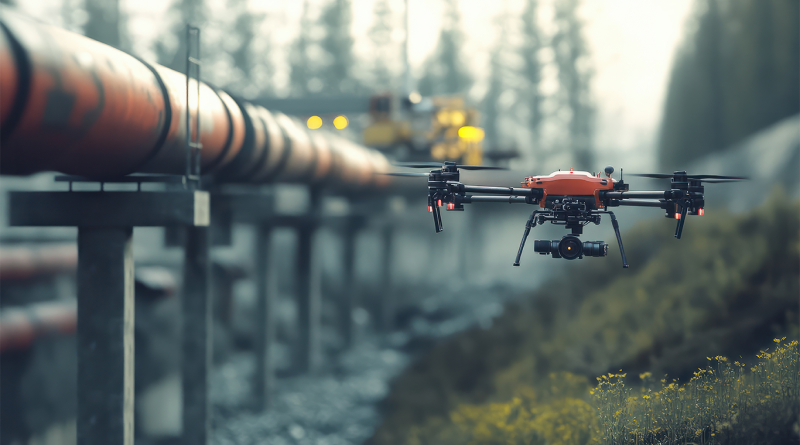
Pipelines can stretch for hundreds or thousands of kilometres, often crossing remote terrain that is difficult to inspect from the ground. Drones offer operators another way to monitor these networks, carrying cameras, thermal imaging equipment, LiDAR and other sensors over infrastructure without requiring an inspector to physically cover the same ground.
The potential goes beyond taking photographs. Autonomous drone systems are increasingly being developed to conduct repeatable inspection missions and create datasets that can be compared over time. The result is a model in which operators can identify changes, prioritise further investigation and direct human inspectors to locations where their expertise is most valuable.
The technology is particularly significant because inspection is not a one-off requirement. Pipelines, storage sites and production facilities must be monitored throughout their operating lives. Making those inspections faster and more repeatable could change the economics of asset integrity.
2. Finding and measuring methane leaks
Methane monitoring has become one of the most important applications for drones in oil and gas. Equipped with specialist sensors, unmanned aircraft can survey facilities and identify emissions from above, helping operators locate leaks that might otherwise require extensive ground-level investigation.
In June, Australian energy infrastructure company APA trialled drone-based methane detection at its Dandenong LNG facility. The drone carried Gas Mapping LiDAR and flew at approximately 70 metres, allowing it to pinpoint methane sources to within 2 metres, according to the company. APA said drones could also make monitoring smaller assets more cost-effective than using helicopters.
That combination of precision and mobility is important. Rather than simply establishing that methane is present somewhere across a facility, aerial sensing can help teams understand where emissions are originating and how large they are, giving operators better information for maintenance and emissions management.
3. Inspecting tanks, flare stacks and elevated assets
Some of the industry’s most routine inspections can also be among its most complicated. Tanks, flare stacks and other elevated or enclosed structures have traditionally required scaffolding, rope access or confined-space entry.
Drones can reduce some of that physical access requirement by taking inspection equipment directly to the asset. Cameras provide detailed visual surveys, while increasingly specialised payloads allow drones to perform measurements rather than simply capture images.
This is pushing the technology into areas previously reserved for conventional inspection teams. The change matters because the business case for robotics is not simply about reducing labour. Removing scaffolding, shortening inspection periods and limiting the amount of time assets need to be taken out of operation can influence the overall economics of maintenance.
4. Conducting autonomous inspection rounds
Not every useful industrial robot flies. Ground-based robots are increasingly being deployed to perform routine rounds at oil and gas facilities, collecting information while keeping employees away from potentially hazardous areas.
ADNOC deployed a heavy-duty Taurob inspection robot at its Taweelah Gas Compression Plant in May. The autonomous machine uses technologies including 3D LiDAR and thermal cameras with 360-degree visibility. It can identify potential gas leaks, abnormal hotspots and other hazards during routine inspections.
This points to an important development in oil and gas technology. Inspection robots are becoming mobile sensor platforms. Shell, for example, describes robots that can conduct autonomous gas-detection rounds and collect images, video and audio for analysis.
Instead of sending an employee to repeatedly check the same equipment, facilities can potentially collect information continuously and send people when the data indicates intervention is needed.
5. Crawling inside pipes and confined equipment
The value of robotics becomes particularly clear when the destination is somewhere a person should not, or cannot, easily go.
Robotic crawlers can carry nondestructive testing sensors into pipes, tanks and vessels to search for corrosion, cracking and other integrity problems. The technology can reduce the need for scaffolding and confined-space entry while bringing inspection sensors closer to difficult-to-reach components.
These machines also illustrate why robotics should not be viewed as a single technology category. Aerial drones, wheeled robots and pipe crawlers solve very different physical problems, but they share the same underlying objective: moving sensors to the asset rather than moving people into hazardous or inaccessible environments.
6. Taking autonomous inspection to the seabed
Offshore energy presents an even more demanding inspection problem. Subsea infrastructure can sit hundreds or thousands of metres below the surface, making conventional inspection dependent on specialised vessels and remotely operated equipment.
Saipem’s FlatFish shows how autonomous robotics could alter that model. The underwater drone has completed autonomous missions including pipeline and structural inspections, cathodic protection measurements and wall-thickness assessments during testing for Petrobras. It is designed to operate at depths of up to 3,000 metres.
Saipem is also developing subsea robots capable of remaining on the seabed for extended periods. Its Hydrone ecosystem includes systems designed to alternate between autonomous missions and recharging at subsea docking stations, with continuous seabed deployment of up to 12 months.
That opens the possibility of moving from vessel-led inspection campaigns toward subsea robots that are already resident near the infrastructure they monitor.
7. Building continuous, data-driven asset monitoring
Perhaps the most consequential application is not any individual robot, but what happens when machines become part of a wider monitoring system.
Drones and robots can repeatedly collect visual, thermal, acoustic, gas and structural data. Software can then compare those readings with previous inspections and help identify anomalies. Instead of waiting for the next scheduled inspection to discover a developing problem, operators can potentially spot changes earlier.
This does not remove people from the equation. It changes their role. Engineers still need to interpret findings, understand risk and decide what action should follow. What robotics can increasingly remove is the requirement for a person to physically enter every location simply to gather the information.
That distinction may ultimately define the role of robotics in oil and gas. The industry is not simply replacing inspectors with machines. It is changing where inspection happens, how frequently information can be collected and how quickly companies can act on what their assets are telling them.