Aviation leaders are calling for a ‘pragmatic’ approach to decarbonization. Alyssa Norris explains how that looks

Earlier this year, the World Economic Forum polled aviation leaders on the outlook for meaningful progress on aviation decarbonization in the year ahead. The response, overwhelmingly, was a call for pragmatism – as the report notes, “there is an emerging consensus across the stakeholders consulted for this report that a more pragmatic approach to decarbonization is now needed. So, while the targets and ambitions have not budged, the path to achieve them may require modifying to address roadblocks, both decarbonization-specific and systemic.”
Specifically, this need is driven by growing political and economic uncertainty, which has only intensified since the report came out, with war in Iran and a spike in oil prices. This has led airlines to impose fuel surcharges and abandon weaker-demand routes, highlighting that the stability and predictability that long term decarbonization transitions rely on is under threat.
This focus of this pragmatism in the short term largely concerns sustainable aviation fuel and how fast it can scale; while other measures such as aircraft efficiency are key, the development of lower carbon fuels is imperative. Respondents were mainly concerned about two key issues; 1. the availability of existing feedstocks such as used cooking oil, which are highly centralized and prone to disruption, interruption, and subject to high demand – and 2. the readiness of e-fuel technology, which continues to be seen as a long-term bet.
Increasing alternatives
A pragmatic approach means expanding our options beyond the binary of HEFA-based SAF and e-fuels and instead encourages adopting an approach that can make use of multiple waste carbon feedstock streams that are currently abundant, well-distributed around the world, and feasible to scale up in both the near and long term. This not only helps establish a more resilient network of supply chains on which to scale up production, but it brings down costs by unlocking a far wider range of alternatives to current feedstocks like used cooking oil.
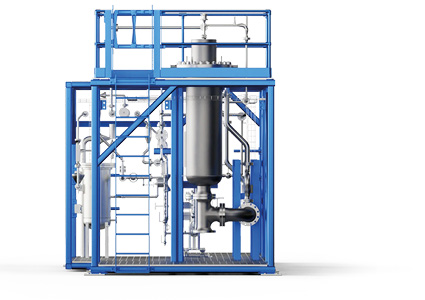
Breakthrough technology, like the Aether AuroraTM now enables us to utilize a broad range of alternative waste carbon streams – including industrial waste gases, agricultural and forestry waste, biogas, and captured CO2 in combination with clean hydrogen.
This involves intensifying the well-established Fischer Tropsch (FT) process, which combines a mixture of carbon monoxide and hydrogen, and converts them into liquid hydrocarbons. There are three basic steps to producing SAF through the FT process: syngas generation (where the feed gases are converted into H2 and CO), the FT step (where the syngas is converted into raw hydrocarbons), and upgrading (where the raw hydrocarbons are converted into finished fuels).
Diverse feedstocks
Over the last decade, the FT step has seen great innovation at the scales relevant to sustainable fuel production, and such progress has lowered plant capital expenditure for fuels projects. There is room for innovation around the syngas generation and upgrading steps, which leads to substantial CAPEX savings, so that combined with state-of-the-art FT, we can realize dramatically lower overall costs at the right scale to make use of a diverse range of feedstocks.

Each of these feedstock streams has challenges, but the key point is that with the right production technology there is plenty of waste carbon available to service the aviation industry’s SAF demand – up to 100 percent adoption.
Accelerating technology
Utilizing these feedstocks economically isn’t without challenges – they are typically dispersed, both geographically, and throughout different industries, increasing transport and logistics costs. Some come with extra complications. For instance, green hydrogen relies on large quantities of renewable energy, and the development of appropriate hydrogen-facilitating infrastructure before it can scale up to create meaningful amounts of SAF. Municipal solid waste (MSW) is abundant and infrastructure for collection already exists, but sorting and processing is expensive and the wide compositional variability makes using such feedstocks for direct fuel synthesis challenging.
Starting with feedstocks that are relatively easy to utilize and/or which are already being aggregated – like biogas, industrial waste gas, or forestry waste – can provide a way to scale and mature next generation production technologies today and provide the market with more SAF sooner. Ideally these production technologies should also have the flexibility to use a range of feedstocks so that as more challenging feedstocks like MSW, or feedstocks that need to scale and become more economical, like direct air captured CO2 and green H2, these production technologies can be reapplied and leverage their maturity in future plants. Crucially, this technology already exists, and is accelerating quickly, giving us a solution to develop practical and economical SAF.
Pragmatism and resilience are likely to be the guiding principles as the aviation sector carefully manages its journey towards a low carbon future through an increasingly uncertain world. Feedstock flexibility enables this, by diversifying and derisking SAF production away from any single pathway and should be an integral part of future conversations about what an often abstract ‘pragmatic approach’ looks like in practice.
Alyssa Norris
www.aetherfuels.com
Alyssa Norris is Director of Sustainability at Aether Fuels, a climate technology company revolutionizing sustainable fuel production and help-to-abate industries like aviation and ocean shipping to achieve their decarbonization goals. Its breakthrough Aether AuroraTM technology converts waste carbon into drop-in liquid fuels with near-ideal carbon conversion efficiency. The scalable solution addresses the core requirements of next-generation sustainable fuels by increasing production yields and reducing capital costs while utilizing a diverse range of feedstocks.