Discover how LG&E and KU are adding nearly a third more power capacity to Kentucky’s grid

Serving nearly 1.4 million customers across Kentucky and parts of Virginia, Louisville Gas and Electric Company and Kentucky Utilities Company (LG&E and KU) have built a reputation for reliability. The utilities stand out thanks to their strategic investments in advanced technologies combined with a stable regulatory environment amid rising demand for power.
“As vertically integrated, regulated sister utilities in Kentucky, we own and operate our power plants and the transmission and distribution systems to deliver electricity to our customers, and the power we generate is prioritized for our customers. On the gas side of our business, we own and operate underground natural gas storage fields, compressor stations and gas systems that deliver gas to our customers’ homes and businesses. We currently have approximately 7,200 megawatts of power generation capacity, comprising coal-fired, natural gas, hydro, and solar, with battery storage coming soon, and our power plant fleet is one of the most reliable in the nation,” opens Liz Pratt, Senior Director of Communications and Corporate Responsibility.
Enabling the transition
Over the past several years, LG&E and KU have received approval from the Kentucky Public Service Commission (KPSC) to expand their power generation capacity as part of their generation investment plan. Several significant projects are on the horizon, each designed to ensure the utilities continue delivering safe and reliable service to customers. One of the most important is Mill Creek 5, which plays a strategic role in LG&E and KU’s generation transition. Dave Tummonds, Vice President of Power Generation, sheds light on what motivated the project. “When we filed our certificate of public convenience and necessity (CPCN) at the end of 2022, we looked to economically retire coal-fired units and replace them with gas. We planned to build two new power generation units and retire four coal units, one of which was already slated to be economically retired. We received approval to build one of those units, while the second was delayed.
“The driving force behind Mill Creek 5 was that transition from coal to gas, and what we have seen since has been tremendous economic development in Kentucky. That growth has led us to reconsider the timeline for retiring the remaining coal units. Consequently, we need to keep most of them running as long as possible to meet the added demand coming into Kentucky, whether from normal load growth, industrial expansion or data centers,” Dave emphasizes.
Multiple projects
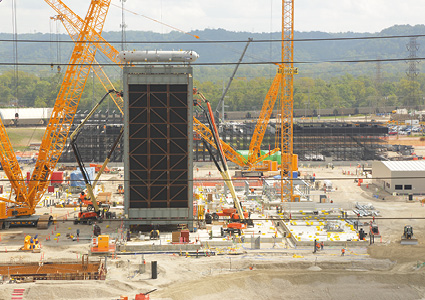
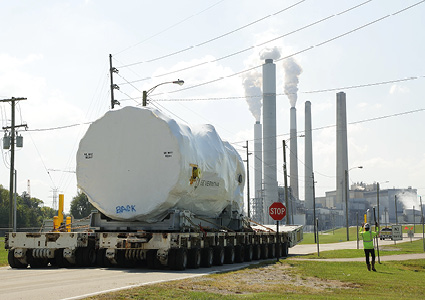
Senior Director of Project Engineering, Jeff Heun discusses the project in greater detail. “For Mill Creek 5, it is essentially a retirement, replacement and load growth project. Currently, we are looking at a one-on-one advanced class combined cycle unit, including one gas turbine and one steam turbine, producing approximately 645 MW. We have partnered with GE Vernova on their 7HA.03 gas turbine and are working with The Industrial Company, a subsidiary of Kiewit, to manage engineering, procurement and construction of that unit. The contract was awarded in 2024 and construction is well underway, with below-ground foundation work completed earlier this year. We are now focusing on structural steel, piping and detailed electrical work. Overall, the project has been progressing well, and we remain on schedule for first fire at the end of this year, with commercial operation expected to begin by the middle of next year,” he enlightens.
Mill Creek 5 is far from the only project keeping LG&E and KU busy. Beyond that, LG&E and KU are progressing with several other projects that were part of the 2022 filing, including a 125 MW battery storage project developed in partnership with Tesla, which is expected to come online in early 2027. The utilities are also building two 120 MW single-axis tracker solar arrays.
While all these projects are under construction, the utilities are actively moving forward with broader ambitions in terms of generation mix after receiving approval from the KPSC following an additional CPCN filing in 2025. Looking ahead, the utilities plan to build Mill Creek 6 as a sister unit alongside Mill Creek 5, as well as another natural gas combined cycle unit, Brown 12, at the utilities’ E.W. Brown Generating Station.
The scale of what is currently underway is significant, and Jeff puts it in perspective. “If a technology meets our customers’ needs, represents the least-cost solution within the regulatory framework and is in the benefit of the ratepayer, we will consider implementing it, as we are technology agnostic. Construction wise, we are building over two gigawatts of power capacity and have just under $5 billion worth of projects currently in the queue. That is a substantial program when considering that our existing capacity sits at around 7200 megawatts, so we are effectively adding close to a third more on top of that. Economic development in Kentucky continues to grow and could lead to additional projects in the future. It is a genuinely exciting time for us,” he concludes.
Between the construction of Mill Creek 5 and the power generation capacity in development, the careful balancing of coal retirements with natural gas, solar and battery storage, LG&E and KU are redefining what reliable power looks like in their service areas in Kentucky and Virginia. Building a more flexible and responsive grid while keeping costs affordable for ratepayers is a complex task; one the utilities are actively working to achieve.