Global OTEC completes world’s first offshore ocean heat energy platform

Subscribe to our free newsletter today to keep up to date with the latest energy, oil and gas news.
Ocean thermal energy conversion has spent decades sitting at the edge of the renewable energy industry, often discussed as a promising technology that never reached commercial viability. That may be starting to change.
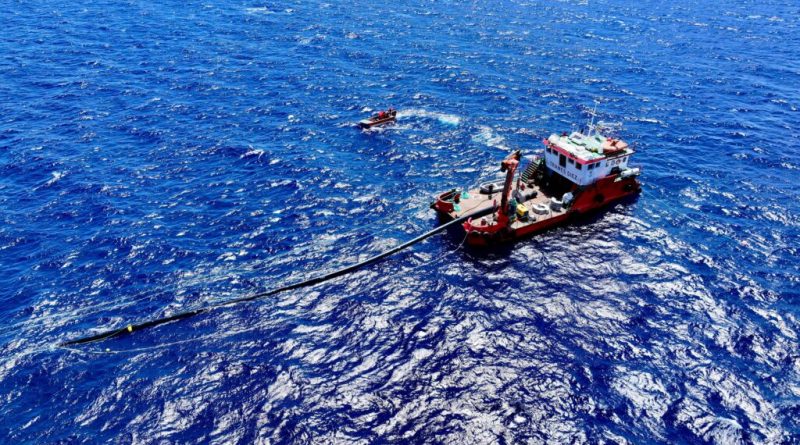
UK-based developer Global OTEC recently completed installation of what it describes as the world’s first purpose-built offshore platform for ocean thermal energy conversion, or OTEC, off the coast of Gran Canaria. The project marks a technical milestone for a sector that has historically struggled with engineering complexity, financing hurdles and doubts around scalability.
Unlike solar and wind generation, OTEC systems are designed to deliver continuous baseload electricity by exploiting the temperature difference between warm surface seawater and colder deep ocean water. In tropical regions, where temperature gradients remain relatively stable year-round, advocates argue the technology could provide a dependable renewable power source for island economies that continue to rely heavily on imported diesel.
The platform installation forms part of the PLOTEC project, supported by the European Union’s Horizon Europe program. The deployment is taking place at PLOCAN, the Oceanic Platform of the Canary Islands, which has become a testing ground for offshore renewable technologies.
For the offshore energy industry, the project is less about immediate commercial output and more about proving that one of marine energy’s most persistent engineering challenges can be addressed in real operating conditions.
Why offshore deployment could solve one of OTEC’s biggest engineering problems
OTEC systems generate electricity through a relatively simple thermodynamic process. Warm surface seawater heats a working fluid with a low boiling point, creating vapor that drives a turbine. Cold seawater pumped from deep below the ocean surface then condenses the vapor back into liquid form, allowing the cycle to repeat continuously.
The concept itself is not new. Engineers and researchers have studied OTEC for more than a century. The problem has largely been economics and infrastructure.
Traditional onshore OTEC systems require extremely long cold-water intake pipes extending deep into the ocean. These pipes are difficult and expensive to manufacture, transport and maintain. Storm exposure and corrosion risks add another layer of operational uncertainty.
Global OTEC argues that offshore deployment changes the equation significantly. By positioning the platform directly above deep water, the company says pipe lengths can be reduced by as much as 80%, potentially lowering installation costs and improving long-term system reliability.
One of the most important parts of the recent deployment involved installation of the platform’s vertical seawater intake riser. The structure is responsible for transporting cold seawater from deep below the surface to the energy conversion system above. Offshore Energy reported that the operation represented one of the most technically difficult stages of offshore OTEC development.
The platform itself remains relatively small in scale. Its purpose is validation rather than commercial electricity production. Still, proving that critical offshore components can operate in open-water conditions is an important step for a sector seeking investor confidence.
The broader offshore renewables market has seen similar development paths before. Floating wind projects, once considered prohibitively difficult, gradually advanced through years of pilot demonstrations before attracting large-scale capital investment.
Island economies are becoming the proving ground for continuous ocean energy
The strongest commercial case for OTEC may not emerge in major industrial economies first. Island nations and remote coastal regions are increasingly viewed as the technology’s most realistic early market.
Many tropical islands remain heavily dependent on imported fossil fuels for electricity generation. Diesel imports expose utilities and governments to volatile fuel prices, shipping disruptions and high electricity costs. Grid systems are often small and isolated, making energy resilience a persistent challenge.
Solar and wind power have expanded rapidly across island markets, though intermittency remains a constraint. Battery storage can help stabilize supply, though scaling storage infrastructure remains expensive for many developing economies.
This is where OTEC’s baseload capability becomes commercially attractive. Unlike weather-dependent renewables, ocean temperature gradients remain relatively constant in suitable regions. That allows OTEC plants to operate continuously throughout the day and night.
Global OTEC estimates that more than 25 GW of fossil fuel electricity generation across tropical islands could eventually be replaced by OTEC systems. The company’s long-term strategy centers on modular offshore systems that can be deployed near island communities with suitable ocean conditions.
The next commercial phase may take place in Hawaii, where Global OTEC plans to deploy its first operational OTEC Power Module following offshore testing and validation work in the Canary Islands.
For island governments pursuing decarbonization targets, the appeal extends beyond emissions reductions. Stable locally produced electricity could improve energy security while reducing exposure to imported fuel costs.
The challenge is whether OTEC can reach cost competitiveness quickly enough to establish itself before battery economics improve further.
Marine renewable energy has a long history of ambitious concepts struggling to reach commercial scale. Wave energy developers, tidal projects and other ocean technologies have often faced difficult economics alongside demanding offshore operating environments.
OTEC has faced similar skepticism for years. High capital expenditure, large infrastructure requirements and relatively low thermal efficiency have historically limited investor appetite.
Governments are increasingly searching for dispatchable low-carbon electricity sources capable of supporting grid stability as renewable penetration rises. Offshore engineering capabilities developed through oil and gas and floating wind projects are also creating new opportunities for marine energy technologies once considered impractical.
The International Renewable Energy Agency has previously estimated that global OTEC generation potential could theoretically reach 10,000 TWh annually, though practical deployment would represent only a fraction of that figure.
European funding support is also helping the sector move beyond laboratory-scale research. Horizon Europe backing for projects such as PLOTEC reflects growing institutional interest in technologies that could support energy independence in remote or geographically constrained regions.
Source
Photo credit