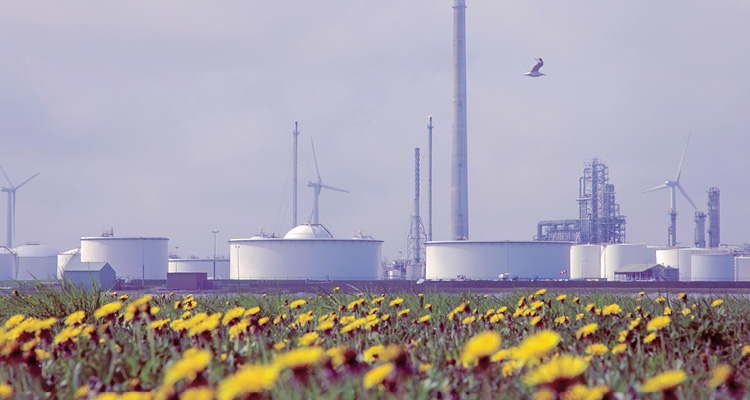
Joachim Boese explains how connected operations help oil producers respond faster to geopolitical shocks and market volatility

Since the outbreak of the US-Iran war, the oil industry has been forced to reckon with one of the most challenging operating environments in decades. With supply now disrupted on two fronts, the Strait of Hormuz and the Red Sea, crude prices have hit $100 in recent weeks as markets react to every military strike and diplomatic tweet.
Refiners and producers are grappling with supply-chain bottlenecks, higher freight costs, and growing signs of demand erosion as sustained high energy prices dampen spending.

The industry is no stranger to complex global supply chains. But this new challenge requires companies to adapt to a market where both supply and demand can pivot quickly.
Unpredictable times
In this operating environment, every piece of information counts across suppliers, logistics providers, operations teams, and customers. By knitting together a comprehensive minute-by-minute operational snapshot of the global energy landscape, companies can predict, analyze and react to volatile energy conditions with optimal precision.
In the five months since the start of the conflict, Brent crude has traded in a range from roughly six percent below its pre-war level to almost 50 percent above it. This geopolitical landscape creates complex challenges for producers and refiners.
Periods of volatility also create significant commercial opportunities for companies ready to move quickly. A sudden spike in crude prices can open a brief window for higher margins.
Companies operating with connected data can rapidly adjust production plans and redirect cargoes, turning market turbulence into a competitive advantage.
Building resilience and agility
Historically, energy companies have been primarily motivated by efficiency and cost margins. While those objectives still stand, organizations are increasingly finding that resilience and agility are key performance differentiators.
Companies become more resilient when they operate from a common view of data and performance. To use a boating analogy, we’re all navigating the same storm. Some organizations have cargo ships, others have yachts. The conditions are the same for everyone; what differs is how well-equipped each vessel is to withstand rough seas.
Connected operational systems help organizations build a stronger boat. Increasingly, that means looking beyond any single company and to every entity who touches the barrel.
Seeing the big picture
In what experts describe as the ‘age of permacrisis,’ supply shocks often overlap or occur simultaneously. For example, disruption in Hormuz, renewed Red Sea attacks, or tighter sanctions on Russian exports can affect crude availability and shipping routes within hours, and sometimes all at once.
Refineries process blends and crude slates sourced from multiple regions, each with distinct physical properties and refining characteristics. Texas crude behaves differently from Saudi crude. Saudi crude behaves differently from Abu Dhabi crude. Venezuelan crude behaves differently again.
Historically, engineering teams would manually run a limited number of operational scenarios. Today, connected AI systems can run thousands of crude blend combinations at once, considering crude prices, refined product prices, electricity costs, operational constraints, and regional market demand. This approach allows them to determine in near real time exactly which combination delivers the best profitability.
Connection in action
Abu Dhabi National Oil Company (Adnoc) offers an example of connected operations in practice. The energy giant has combined data from production assets, pipelines, terminals and operations teams into a shared operational environment.
The platform integrates more than ten million data tags across 120-plus dashboards, giving decision-makers a single operational view of the business. The system generates $60 million to $100 million in savings through optimized operations across 14 subsidiaries, enabling the company to respond faster when market conditions or supply chains shift.
In a broader sense, the highest-performing organizations globally are being recognized not just for productivity, but for supply chain resilience and their ability to connect data across entire value chains.

According to McKinsey analysis of the World Economic Forum Global Lighthouse Network, organizations that digitally connect suppliers, operations and customers experienced eight times less revenue shock following the pandemic than their peers.
Those connected value chains also achieved 50 percent faster new-product introduction by improving visibility and coordination across the network.
Digitizing relationships
Industrial resilience is rapidly shifting from being an internal capability to a network capability. Competitive advantage increasingly depends on how well producers, refiners, suppliers, logistics providers, and technology partners operate from a shared understanding of data and performance.
In the last decade, industrial companies prioritized digitizing assets. The next phase will see digitizing relationships come to the forefront.
Joachim Boese
www.aveva.com/en
Joachim Boese is Industry Principal, Oil & Gas at AVEVA, with more than 35 years’ industry experience across international operating companies and solution providers. He works with major customers to improve operational efficiency and sustainability. Earlier in his career, Joachim served at ConocoPhillips and Deutsche Shell. AVEVA is a leading industrial technology company, supplying software which powers radical collaboration.