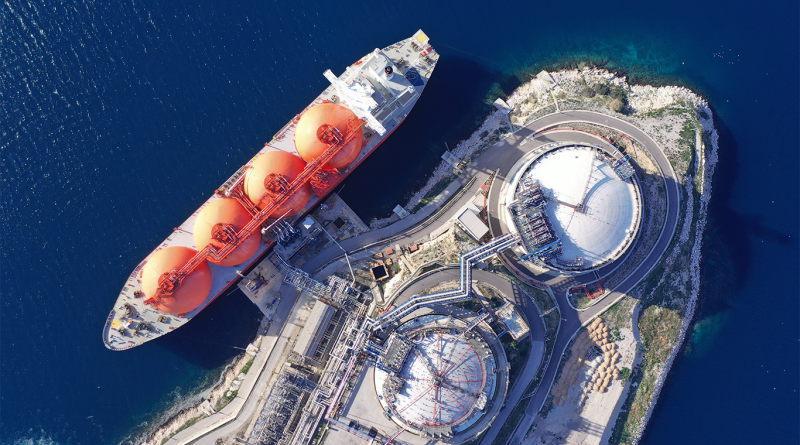
US LNG exports rise 23% in first half of 2026


Subscribe to our free newsletter today to keep up to date with the latest energy, oil and gas news.
US liquefied natural gas exports surged in the first half of 2026 as new production capacity collided with disruption in one of the world’s most important energy corridors, strengthening America’s position as a critical supplier to global gas markets.
US LNG exports averaged 17.4 billion cubic feet per day, or Bcf/d, during the first six months of 2026, an increase of 23 percent compared with the same period a year earlier, according to the US Energy Information Administration.
It was the fastest rate of export growth since the United States began large-scale LNG exports in 2016. The EIA expects shipments to remain close to current levels, averaging 17.3 Bcf/d during the second half of 2026, before climbing to 18.7 Bcf/d in the first half of 2027.
The expansion reflects two forces moving simultaneously. Billions of dollars of new US LNG infrastructure are entering service, giving exporters more gas to sell overseas. At the same time, disruption to LNG shipments through the Strait of Hormuz has tightened international supply and strengthened demand for cargoes that can be sourced outside the Middle East.
For US LNG producers, that combination has provided an unusually favorable environment in which to ramp up new facilities.
New LNG capacity changes the equation
Much of the growth in US LNG exports is being driven by projects that have recently entered service or expanded production.
Venture Global’s Plaquemines LNG facility in Louisiana is exporting at full capacity, while Cheniere Energy’s Corpus Christi Stage 3 expansion in Texas has added another major source of liquefaction capacity.
The EIA said Plaquemines and Corpus Christi Stage 3 will increase nominal US LNG export capacity by a combined 4 Bcf/d when complete. Corpus Christi Stage 3 was exporting from six of its seven liquefaction trains at the time of the agency’s September analysis.
Golden Pass LNG is adding another layer of supply.
The Texas facility shipped its first cargo from Train 1 on April 22, just over three weeks after producing its first LNG. The terminal is being developed by QatarEnergy, which owns 70 percent, and ExxonMobil, which owns the remaining 30 percent.
Train 1 has nominal capacity of approximately 0.7 Bcf/d. Golden Pass is expected to continue increasing exports from the train through the end of the year, while Train 2 is expected to be completed in late 2026. A third train is planned to follow.
Once all three are operating, Golden Pass will have nominal capacity of approximately 2 Bcf/d and peak capacity of 2.4 Bcf/d, according to the EIA. That would make it one of the largest LNG export facilities in the United States.
The significance extends beyond individual terminals. New liquefaction capacity is increasing the volume of natural gas that the United States can place into an increasingly interconnected global market.
The timing has proved particularly important.
High prices pull more American LNG toward Asia
Global LNG prices remained high enough during the first half of 2026 to encourage US terminals to operate near maximum output levels, according to the EIA.
That incentive became stronger following disruption in the Strait of Hormuz.
In March, interruptions to shipments through the waterway affected roughly 20 percent of global LNG supply, predominantly volumes originating in Qatar. The loss was particularly significant for Asian markets because buyers in the region normally receive about 80 percent of Qatar’s LNG exports.
With fewer Qatari cargoes available, Asian importers were forced to compete more aggressively for LNG on the spot market.
The impact could be seen in benchmark prices.
Europe’s Title Transfer Facility benchmark averaged $14.74 per million British thermal units during the first half of 2026, according to figures cited by the EIA. That compared with $13.10/MMBtu during the same period in 2025 and represented the highest first-half average since the energy crisis that followed Russia’s 2022 invasion of Ukraine.
Prices were even higher in Asia.
The Japan-Korea Marker, a key benchmark for LNG delivered into East Asia, averaged $15.56/MMBtu during the first six months of 2026. That was $2.38/MMBtu higher than a year earlier and its highest first-half level since 2022.
The result was a significant change in US LNG trade flows.
American LNG exports to Asia increased by 2.3 Bcf/d, or 108 percent, compared with the first half of 2025. Shipments to Europe also increased, although by a much smaller 0.1 Bcf/d, or 1 percent.
Exports to Latin America, the Caribbean, the Middle East and North Africa collectively increased by 0.8 Bcf/d, or 46 percent.
Egypt and the Netherlands were among the largest individual destinations, each receiving about 1.7 Bcf/d. Italy followed at 1.4 Bcf/d, France at 1.2 Bcf/d and the United Kingdom at 1.1 Bcf/d.
Those flows illustrate one of the defining characteristics of US LNG. Cargoes can respond to changes in regional demand and pricing, allowing supply to shift when shortages emerge elsewhere.
US LNG takes a larger role in global supply
The latest figures suggest the expansion of US LNG is moving into another phase.
The first wave established the United States as a major exporter. The current construction cycle is increasing the scale at which its terminals can influence international supply.
That influence could grow further in 2027.
Beyond the remaining Golden Pass capacity, the EIA has identified Port Arthur LNG Phase 1 and the first two trains at Rio Grande LNG among projects expected to begin exports in 2027. Port Arthur Phase 1 is expected to add around 1.6 Bcf/d of capacity, while the first two Rio Grande trains are expected to contribute about 1.4 Bcf/d.
More capacity does not guarantee continuously higher exports. Maintenance schedules, commissioning delays, US natural gas prices and international price spreads can all affect terminal utilization. Global demand will also determine whether incremental American supply can be absorbed at commercially attractive prices.
Yet the events of 2026 demonstrate why flexible LNG capacity has become increasingly valuable.
When a disruption removed a significant share of Middle Eastern supply from the market, buyers sought replacement cargoes. US terminals were simultaneously increasing production, enabling more gas to move toward markets prepared to pay for it.
With the EIA forecasting US LNG exports of 18.7 Bcf/d in the first half of 2027 and further liquefaction capacity approaching startup, the country’s role is shifting from that of a fast-growing exporter to something more consequential: a major balancing source for an increasingly global natural gas market.
Source: